
Golf Ball Washers Legionella Risk:
Are They Safe on UK Golf Courses?
A while ago here at the Dynamika blog, we posted an article about legionella at golf courses; covering irrigation systems at golfing greens, club house water facilities, and the hidden dangers of ignoring their maintenance.
But there’s one key piece of equipment at golf courses and driving ranges that we haven’t talked about yet…
Golf ball washers and club washers promise to clear away the debris from golf equipment; so players won’t have their shots spoiled by the aerodynamic drag of stray mud and grass.
Unfortunately, for golfing facility owners, they also come with their own risks for potentially deadly legionella growth and spread. Read on to learn more…
Legionella explained
As a quick recap, Legionella is the bacterium responsible for the potentially deadly Legionnaire’s disease.
It’s found naturally in rivers and streams, where the bacteria doesn’t pose much of a threat to health; but it can become a serious problem when it enters man-made water systems.
In stagnant water and temperatures of 20°C to 45°C, Legionella can quickly multiply and then spread through the air via aerosolised water droplets; potentially infecting anyone unlucky enough to breathe them in.
Legionella outbreaks are of course taken very seriously. As part of the regulations of the Health and Safety at Work Act 1974, all businesses (including golfing facilities) must take reasonable steps to control the risks of legionella.
The Health and Safety Executive (or HSE) can inspect your workplace at any time to ensure your compliance with the regulations; with non-compliance punishable by major fines or even imprisonment. Find out more at HSE Legionella regulations.
So, what makes golf ball washers and club washers a possible legionella risk area?


Understanding the risks
Let’s define what we mean by ball washers and club washers. There’s a few different types out there, with different levels of risk for each:
- Course-mounted washers (or range-mounted washers)
- Portable cart-mounted washers
- Commercial large-capacity washers
Let’s go over each one…
Course-mounted ball washers
Some courses/driving ranges feature golf ball washers and club shoe washers for patron use; although the former especially is becoming less popular at modern golf courses.
Course-mounted golf ball washers typically feature a plunger design. The user dunks the ball in and out of a manually-filled water reservoir fitted with internal bristles, which clear away the mud and grass.
Meanwhile, course-mounted club washers are effectively just a water bucket. Some are fitted with internal bristles, while others come with a handheld brush.
Thanks to low water quantity, low aerosolisation and physical separation from other water sources, these kinds of washers pose a relatively small risk for legionella growth and spread.
However, poorly-maintained washers can still provide a breeding ground for bacteria; especially as sunny days can be just warm enough to push these washers into the 20°C to 45°C danger zone for legionella growth.

Portable cart-mounted washers
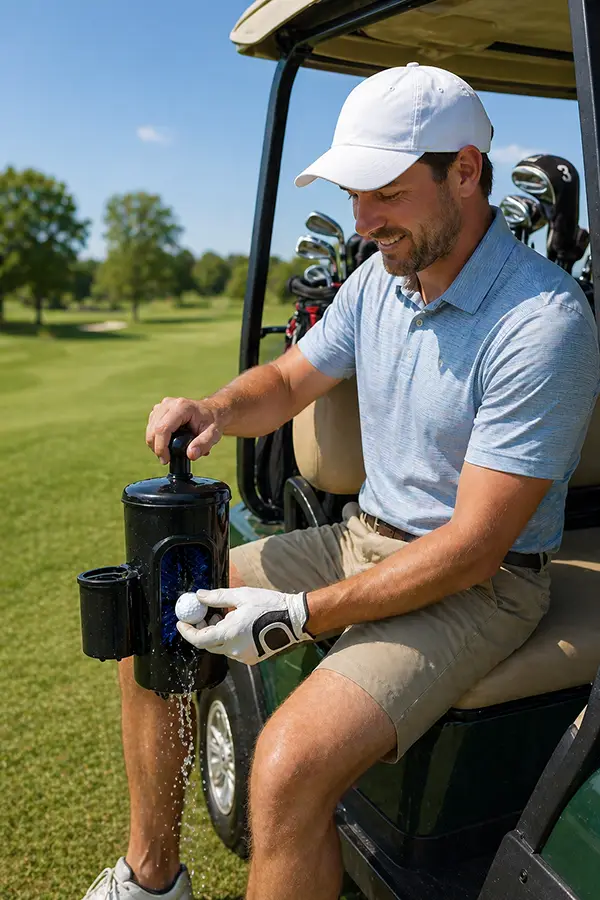
Similarly, portable ball washers and club washers are sometimes installed on golf carts for players to use.
Again, the designs of these washers are usually quite simple; they’re effectively just a fancy water bucket with built-in brushes, which needs to be manually filled.
As long as they’re carefully maintained, the legionella risk level for cart-mounted washers is pretty low.
Commercial large-capacity washers
Many clubhouses use large-capacity ball washers and ultrasonic club cleaning machines to wash large quantities of golf equipment at once.
It’s here where the risk of legionella jumps considerably. Commercial-grade ball washers use larger quantities of water, heated to warmer temperatures; and some designs feature pre-spray and water jet technology which naturally produce a lot of aerosolised water.
Similarly, ultrasonic cleaners naturally produce aerosols which can escape into the outside air (particularly if the machine is not adequately covered).
So, what can be done?
Legionella control measures for golf ball washers & club washers
Thankfully, there’s a number of preventative measures that golf course and driving range managers can take to keep legionella away:
- Course-mounted and cart-mounted washers should be drained and refilled at least every week (if not every day) with an appropriate mixture of water and liquid antibacterial detergent.
- In addition to this, a regular programme of inspection and cleaning should also be implemented for course-mounted and cart-mounted washers.
- For large-capacity ball washers and club washers, tanks should be emptied, cleaned and refilled every day. Internal brushes and spray/jet nozzles should be inspected and cleaned regularly.
- Be sure to use an appropriate antibacterial ball cleaning solution or detergent when refilling the washer machine. Ideally, water should be heated to above 45°C to kill off the legionella bacteria (although keep in mind that temperatures above 60°C can damage golf balls).
- Make sure ultrasonic cleaners are always operated with the lid closed. If your cleaner doesn’t have a lid, get an external lid fitted.
- Ultrasonic cleaners should also be emptied and filters cleaned or replaced on a daily basis. An appropriate disinfectant should be run through the system every week, and a full inspection and replacement of any broken parts should be carried out every month.
- Of course, don’t forget to unplug any electrical washers and cleaning equipment before carrying out maintenance on them!
- Finally, keep in mind that the water supplies used to fill washers should also be subject to a regular legionella control scheme. It’s no good keeping your washer equipment perfectly clean if you’re filling it from infected tanks and hosepipes!
Professional Legionella Testing for Golf Courses
Of course, these are all general points of advice. To make sure your golfing location is fully protected, you should:
- carry out a full legionella risk assessment,
- design and implement legionella control measures tailored to your particular site and working practices
- regularly review the performance of control measures and update them if needed, and
- update your risk assessment and control scheme as any new risks come to light
Need a Legionella risk assessment for your golf course?
Looking to prevent Legionella at your golf course or driving range? Dynamika offers a complete package of legionella risk assessments, disinfection services and water quality testing for golf facilities across the south of England. Find out more or arrange a consultation by calling 03333 22 0800 today.