
Legionella at swimming pools: what’s the risk?
Time for another instalment in our ‘What’s the risk?’ blog series! Today, Dynamika director Brett Wallace looks at swimming pools; where legionella can be an unexpected danger…
When we talk about health and safety risk areas at swimming pools, what first springs to mind for you?
Slippery floors? Deep waters? Diving board falls?
All valid concerns, but there’s another risk area that you might not have considered; and that’s the risk of legionella contamination.
If you own or manage a pool facility, legionella should absolutely be on your radar. This guide explains how the bacteria can take over your pool space; and what you need to do to safeguard swimmers.
Let’s dive in…



How can legionella grow and spread at swimming pools?
At first blush, swimming pools don’t seem like the most likely place for a legionella outbreak. Surely the chlorine takes care of any nasty pathogens?
This is true for the most part. Chlorine disinfection is highly effective at killing free-floating legionella in pool water; among other nasty pathogens.
However, chlorine often struggles with biofilms.
You might be familiar with biofilms as the slimy layer of bacteria that forms on the surface of stagnant water, but they can also build up on the walls, floors, filters and pipes of treated pools too.
In fact, the relatively damp conditions of pool facilities can enable biofilms to form on almost any surface; including poolside walkways and benches.
Biofilms develop from the skin, oils and other organic debris from swimmers, and grow in pools with fluctuating disinfection chemical levels and/or warmer waters. They can quickly become a safe haven for legionella bacteria to breed.
Unfortunately, chlorine struggles to break down biofilms; in fact, a study from 2023 showed that chlorine actually promotes biofilm growth.
Meanwhile, water splashes, bubble jets and other pool features create the mechanism to spread the bacteria through the air.
Unfortunately, that’s not the only risk area when it comes to pool facilities.
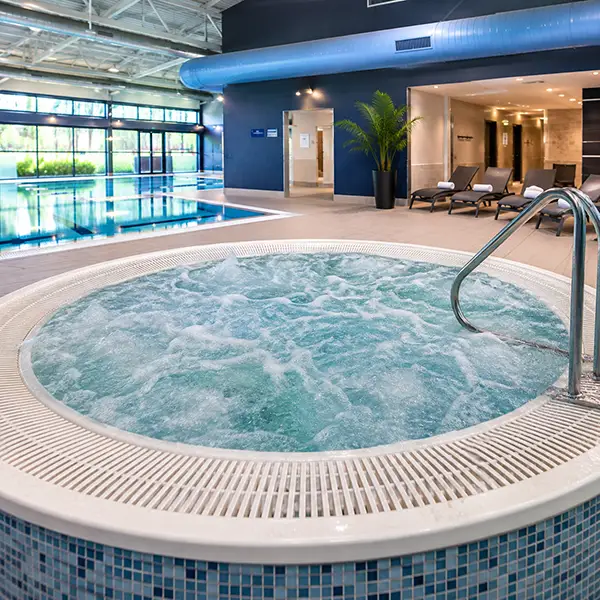
Many pool owners focus their efforts squarely on pool water quality; but poorly maintained hot tubs, spa pools, steam rooms and changing room showers can also become a problem.
Left unchecked, they often provide the ideal temperature and aerosolisation conditions to enable legionella to grow and spread amongst patrons.
Why is legionella control more challenging for swimming pools?
Even here in the UK, pools and hot tubs are more ubiquitous than you might think.
They show up in a lot of different settings; leisure centres, sports clubs, spas, hotels, resorts, holiday homes, cruise ships, theme parks, hydrotherapy and medical centres, high-rise rooftops, even domestic dwellings!
That means there’s really no one-size-fits-all procedure for legionella control. Different pools may have different designs, different capacities and different technologies; and they can be located indoors or out in the open.
Their usage routines can fluctuate wildly, too. For example, an indoor leisure centre pool naturally caters for large numbers of swimmers each day and might stay open all year.
Meanwhile an outdoor holiday home pool might only serve a handful of patrons per day and go through long periods of seasonal inactivity.

What are swimming pool owners’ responsibilities for managing legionella risks?
We talk about the Health and Safety at Work Act 1974 a lot here on the Dynamika blog, and with good reason. It effectively applies to all kinds of commercial premises; and that includes pool facilities.
If you’re a pool owner or manager, you have a legal duty to protect both swimmers and staff from the deadly threat of legionella.
Pools are also subject to the Control of Substances Hazardous to Health (COSHH) regulations – which in this case includes legionella in water systems – and legionella outbreaks must be reported to the Health and Safety Executive under the Reporting of Injuries, Diseases and Dangerous Occurrences Regulations (RIDDOR).
In most cases, private swimming pools and hot tubs on domestic property aren’t subject to the same health and safety regulations. However, if you’re a landlord, a holiday home owner or otherwise rent out the pool facilities to other people, the regulations still apply.
What do I need to do to prevent legionella at my pool?
As usual, the broad strokes of legionella prevention are the same as with most other industries. Pool owners and managers must:
- Carry out a full legionella risk assessment (including not just pool water systems but also other on-site water facilities, such as showers, sinks, drinking fountains and water refill stations)
- Design and implement a control scheme
- Appoint responsible person(s) to manage implementation
- Monitor water systems
- Review risks and control schemes periodically
Generally speaking, all pool owners and managers should be making efforts to regularly clean pools and ancillary water facilities such as showers and faucets. Humidity should be carefully controlled via ventilation and dehumidifier technology, to limit condensation and damp surfaces.
Regular manual cleaning and chemical disinfection should be carried out to address biofilms. As we’ve already covered, typical chlorine dosages alone won’t get the job done, but are there other chemical treatment options available:
- Oxidisers such as chlorine dioxide can break down biofilms and kill the bacteria within pool plumbing systems and can be used to supplement existing chlorine treatments.
- Enzyme cleaners break down the slimy layer of biofilms; exposing the bacteria underneath so that traditional disinfectants can work their magic. Continued usage can also clean away organic waste, which prevents new biofilm formation.
- High ‘shock’ dosages of bromine, monochloramine or even very high quantities of chlorine can be effective at taking down biofilms.
Pools and hot tub periods of seasonal inactivity
For pools and hot tubs which go through periods of seasonal inactivity, appropriate measures should be taken to winterise, maintain and re-commission the pool facilities.(Depending on your setup, this might include things like draining pipework, fitting pool covers and/or carrying out shock treatments.)
Again, though, the exact risks, vulnerabilities and appropriate control measures may often vary wildly from one pool facility to the next. Be sure to review all water systems across your pool site, and tailor your particular control scheme to address your particular site’s needs.
As usual, we recommend reading the Health and Safety Executive’s ACoP L8, which offers practical guidance for complying with the law.
(Depending on your site’s facilities, it might also be worth reading HSG282, which provides specific guidance on hot tubs and spa pools.)
Need help managing legionella risks for your swimming pool?
Dynamika serves leisure centres, hospitality locations and a variety of other industries across the south; with swimming pool legionella risk assessments, water testing services, disinfection services and more. Call us on 03333 22 0800 to book a consultation today.